
Should I Renovate My Kitchen Before Listing My Home In Glen Abbey? Expert Home Staging Tips From Haidan Wang
Should I renovate my kitchen before listing my home in Glen Abbey?
No, you generally should not undergo a major, high-end kitchen overhaul just before selling your property. Instead, focusing on targeted cosmetic upgrades and expert home staging typically yields a much higher return on investment and prevents over-improving for the local market.
The Reality of Kitchen Renovations in Glen Abbey Real Estate
When preparing to sell home assets in premium neighborhoods, it is easy to assume that a massive kitchen renovation is required to attract premium buyers. Glen Abbey is widely celebrated for its executive-style detached houses, mature tree-lined streets, and proximity to the world-renowned Glen Abbey Golf Club. However, over-remodeling right before a listing hits the market can accidentally trap your hard-earned equity.
Data from the Toronto Regional Real Estate Board (TRREB) indicates that the average price for a home in Oakville reached $1.63 million, with detached family homes averaging $2.06 million. Because Glen Abbey homes naturally sit within this high-end bracket, buyers expect structural integrity and functional elegance. But they also want to inject their own stylistic tastes. Spending $60,000 on custom cabinetry might only add $40,000 in perceived market value, resulting in a net loss.
Strategic Alternatives: Smart Staging vs. Major Overhauls
Instead of ripping out drywall, successful home sellers across the GTA, Halton, and surrounding areas like Mississauga and Burlington rely on high-impact cosmetic staging. A carefully curated presentation makes spaces feel updated, bright, and universally appealing without the stress of prolonged construction delays.
1. Reface and Repaint Instead of Replacing
If your kitchen layout is functional but visually dated, do not gut it. Refacing solid cabinet doors or painting them in a crisp, neutral tone like a soft off-white or light gray can completely transform the space. Pair this with modern, streamlined matte black or brushed brass hardware to elevate the entire aesthetic for a fraction of the cost.
2. Upgrade the Countertops and Lighting
Swapping out old laminate or heavily patterned tile for neutral quartz countertops instantly updates a kitchen. Additionally, swap out dated light fixtures for contemporary pendants over the island and ensure your under-cabinet LED lighting works perfectly. In premium markets like Oakville and Milton, proper lighting is essential to showcase a spacious culinary area.
3. Professional Staging Techniques for Kitchens
When a property goes live on the listing service, the kitchen must look immaculate, open, and functional:
Clear the Countertops: Remove blenders, toaster ovens, and knife blocks to maximize visible workspace.
Style Strategically: Place a single, elegant bowl of fresh green apples or a modern vase with minimalist greenery on the island.
Deep Clean Everything: Clean the grout lines, polish stainless steel appliances, and ensure the inside of the oven is spotless.
Local Market Context and Inventory Trends
The Oakville real estate market has officially transitioned into a phase of strategic equilibrium. According to recent figures from the Oakville, Milton and District Real Estate Board, the region maintains a balanced environment with roughly 4.6 months of inventory, and homes spend a median of 25 to 27 days on the market.
This means buyers have options and are looking at properties with a discerning eye. They appreciate a kitchen that looks clean, modern, and ready to use, but they rarely pay a dollar-for-dollar premium for major structural renovations that they didn't pick out themselves.

Protect Your Equity with Professional Advice
Deciding how to allocate your pre-listing budget requires precise local market navigation. Every street—from the expansive lots near Pilgrims Way to the executive properties surrounding local trail systems—attracts distinct buyer demographics.
Haidan Wang pairs an analytical background in project management and engineering with deep local real estate experience to help homeowners identify which minor repairs will drive competitive offers, and which ones will waste capital. Working alongside an ethical professional ensures compliance with standard advertising guidelines and protects your financial interests throughout the selling process.
Disclaimer: Real estate dynamics and hyper-local buyer preferences shift based on seasonal inventory and financial cycles. This guide serves as general market advice. Always consult a licensed real estate professional or professional home stager for a personalized property assessment before investing in capital renovations.
Get Your Free Oakville Home Valuation
Personalized, no-obligation market analysis and net proceeds estimate — from a hyper-local Oakville expert.
Agent:
Brokerage:
Phone:
Email:
Website:
Office:
Haidan Wang
CENTURY 21 Miller Real Estate Ltd., Brokerage
647-990-6879
haidan.wang@century21.ca
haidan-wang.c21.ca
9-209 Speers Road, Oakville
O
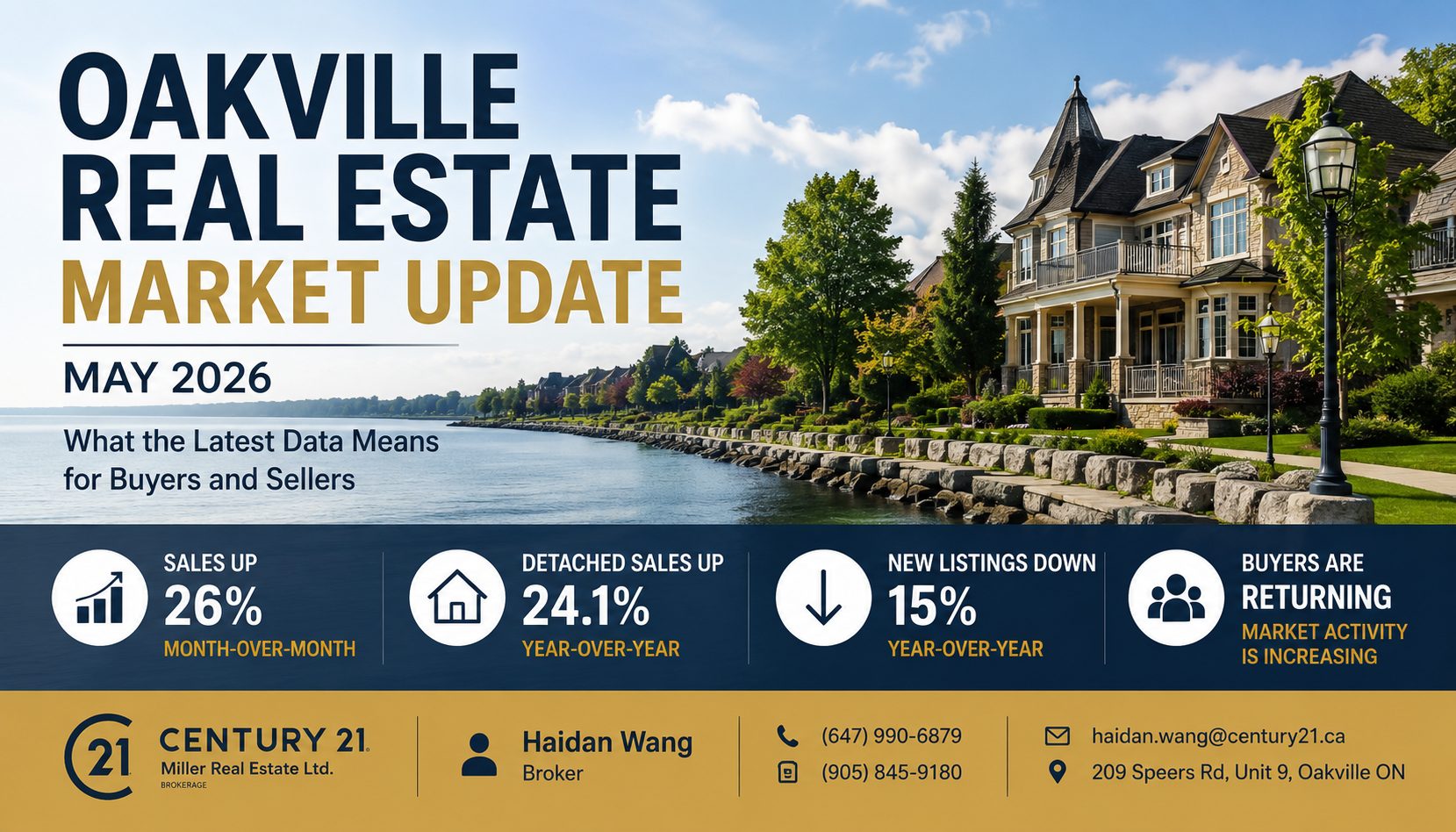
Oakville Real Estate Market Update: Home Sales Rise as Inventory Tightens
What the May 2026 Data Means for Buyers and Sellers
Has the Oakville real estate market finally started to shift?
At first glance, some headlines might suggest that home prices remain under pressure. However, a closer examination of the latest market data tells a more nuanced story. While average prices have fluctuated, buyer activity has increased significantly, especially in the detached home segment.
In May 2026, Oakville recorded 307 residential sales, compared to 244 sales in April. As a result, total transaction volume increased by nearly 26% in just one month. More importantly, detached and semi-detached homes accounted for much of that growth, with sales rising 24.1% compared to May 2025.
Simply put, buyers are returning to the market. After spending much of the past two years adjusting to higher interest rates and economic uncertainty, many purchasers now appear more comfortable moving forward with their plans. Consequently, demand has strengthened across several Oakville neighbourhoods.
At the same time, the number of available homes has not kept pace. This imbalance between supply and demand is beginning to reshape market conditions.
Detached Home Prices Remain Surprisingly Stable
Although many people focus on average sale prices, those numbers do not always tell the full story. Because the mix of homes sold can vary from month to month, headline price statistics sometimes create a misleading impression.
For example, detached and semi-detached homes in Oakville performed remarkably well on a year-over-year basis. The average sale price increased from $1,896,788 in May 2025 to $1,904,074 in May 2026. In other words, prices rose by 0.4%, despite ongoing affordability concerns and elevated borrowing costs.
Equally important, transaction volume increased substantially. Detached home sales climbed from 162 transactions to 201 transactions over the same period. Therefore, the detached housing segment appears to be gaining momentum rather than losing strength.
Rather than experiencing widespread price declines, the detached market seems to be stabilizing while attracting a growing number of buyers.
Inventory Is Shrinking
Perhaps the most important trend in the current Oakville housing market is the decline in new listings.
Across all property types, new listings fell from 938 in May 2025 to 794 in May 2026. That represents a decrease of more than 15%. Meanwhile, detached and semi-detached listings declined by 5%.
Why does this matter?
When inventory falls and buyer demand rises, competition naturally increases. As a result, sellers often receive stronger interest, particularly when their homes are priced correctly and presented well.
Furthermore, fewer new listings mean buyers have fewer options to choose from. Consequently, desirable homes are beginning to sell more quickly than they did earlier in the year.
While Oakville is not yet a seller’s market, the balance is moving away from the extremely buyer-friendly conditions that characterized much of 2025.
Oakville Is Really Two Different Markets
One of the biggest mistakes people make is treating Oakville as a single market. In reality, detached homes and condominiums are following very different paths.
Detached and Semi-Detached Homes
The detached segment continues to show encouraging signs:
- Average sale price increased 0.4%
- Transaction volume increased 24.1%
- New listings declined 5.0%
Taken together, these numbers suggest a healthier market environment than many homeowners expected entering 2026.
Condos, Townhouses, and Apartments
The condominium and townhouse market tells a different story.
Average sale prices declined from $979,639 to $949,837, representing a 3.0% decrease. In addition, transaction volume dropped from 147 sales to 106 sales, a decline of nearly 28%.
As a result, buyers in this segment continue to enjoy more negotiating power. Moreover, sellers of condos and townhouses may need to be especially strategic with pricing and marketing to stand out from competing listings.
What This Means for Sellers
For detached homeowners considering a move, market conditions may be more favorable than the headlines suggest.
Buyer activity is increasing. Inventory remains limited. At the same time, prices have held relatively steady.
Nevertheless, success still depends on proper pricing, strong presentation, and effective marketing. Buyers remain selective, and overpriced homes can still sit on the market.
That said, sellers with well-prepared properties are benefiting from renewed buyer confidence and reduced competition from new listings.
What This Means for Buyers
For detached home buyers, waiting for a major price correction may not produce the results many expected. Demand is increasing, inventory is tightening, and competition for desirable properties is becoming more noticeable.
On the other hand, condo and townhouse buyers continue to have opportunities. Because activity remains slower in that segment, purchasers often have more time to evaluate options and negotiate favorable terms.
Therefore, the best strategy depends largely on the type of property you are planning to purchase.
Looking Ahead
The key trend to watch over the next six months will be the relationship between supply and demand.
If new listings continue to decline while buyer activity continues to rise, Oakville home prices could become more stable, particularly in the detached housing segment.
However, market conditions are unlikely to be uniform across all property types. Detached homes may continue to strengthen, whereas condos and townhouses could remain relatively soft.
Ultimately, the May 2026 data reveals a market that is becoming more active, not weaker. Buyers have returned, inventory is shrinking, and detached homes are showing impressive resilience.
For homeowners, buyers, and investors alike, understanding these changing dynamics will be critical as the Oakville real estate market continues to evolve.



How Much Does It Cost to Sell a Home in Oakville? An Expert Cost Guide
Quick Answer: Selling a home in Oakville typically costs between 6% and 9% of the final sale price. This budget covers real estate brokerage commissions, legal fees, staging, minor repairs, mortgage discharge fees, and moving costs. On a $1.5M Oakville home, sellers commonly net out roughly $90,000-$135,000 in total transaction expenses. Working with a hyper-local expert helps you minimize friction and protect your home equity.
Why Knowing Your Selling Costs Matters
Thinking about listing your Oakville property? Whether you own a detached home in Glen Abbey, a luxury estate in Morrison, or a modern condo along the Burlington-Oakville border, calculating your net proceeds is the most important step of your financial planning – and it’s the step most homeowners skip.
Most sellers focus entirely on the listing price. But protecting your hard-earned equity requires a clear, upfront understanding of the real cost of selling. From staging and professional marketing to legal fees and brokerage commissions, these expenses add up quickly – and surprises at the closing table can shrink your final cheque by tens of thousands of dollars.
This guide breaks down every line-item expense you’ll encounter when selling a home in Oakville, with the local market knowledge of Haidan Wang and the trusted backing of CENTURY 21 Miller Real Estate Ltd., Brokerage. The goal: total financial transparency, and zero surprises.
1. The Biggest Cost: Real Estate Brokerage Commission
The single largest expense when selling a home in Ontario is the real estate commission. In the Greater Toronto Area (GTA) and Halton Region, commission structures are fully transparent and directly fund the deep marketing, negotiation, and legal protections required to secure a premium sale price.
How Commission Works Under TRESA
Under the Trust in Real Estate Services Act (TRESA), Ontario real estate commissions are completely negotiable. Typically, total commission ranges from 4% to 5% of the final sale price, plus 13% HST.
This total fee is usually split between two parties:
- The Listing Brokerage – covers professional photography, 3D virtual tours, hyper-local digital advertising, open houses, and expert negotiation.
- The Cooperating (Buyer’s) Brokerage – incentivizes outside agents to bring qualified, serious buyers to your property.
What Commission Looks Like in Real Numbers
Because Oakville features some of the highest average home prices in the GTA, the numbers matter. For example, if you sell a detached home in Bronte or Joshua Creek for $1,500,000, a 5% total commission equals $75,000 plus HST.
Bottom line: Trying to cut corners on commission by selling without a professional often leads to longer days on market and lower net offers. A premium marketing strategy regularly outpaces the cost of representation by securing a higher final price.
2. Preparing Your Home: Staging & Pre-Listing Repairs
To attract the demographic of buyers shopping in prestigious Halton neighborhoods, your property must look flawless. Oakville buyers expect move-in-ready homes – and they pay a premium for them.
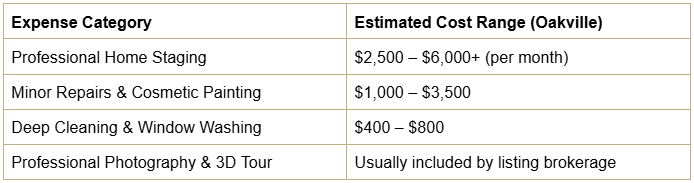
Professional Home Staging
Staging is no longer optional for premium listings. It highlights your home’s architectural strengths and clearly defines each space. For a standard four-bedroom home in Glen Abbey, expect to budget $2,500-$6,000 for a one-month showcase including consultation, furniture rental, and styling. High-Return Pre-Listing Repairs
Before your home goes live, address visible deferred maintenance. The most cost-effective improvements typically include:
- Fresh, neutral paint in high-traffic areas like kitchens and entryways.
- Replacing outdated light fixtures with bright, modern LED alternatives.
- Fixing leaky faucets, cracked tiles, and squeaky flooring.
- Professional deep cleaning, including steam-cleaning carpets and washing all interior and exterior windows.
Haidan Wang works with a vetted network of local Halton contractors who handle these fixes efficiently and at preferred client rates.
3. Closing Costs: Legal Fees & Adjustments
Once you accept an offer, the financial transaction moves to your real estate lawyer. In Ontario, you cannot legally transfer a property title without a licensed lawyer.
Real Estate Lawyer Fees
Your lawyer reviews the Agreement of Purchase and Sale, performs title searches, arranges payoff of your existing mortgage, and handles the secure transfer of funds. For a standard residential sale in Oakville, legal fees and disbursements generally run $1,200-$2,000 plus HST. Property Tax & Utility Adjustments
On closing day, your lawyer presents a Statement of Adjustments. If you’ve prepaid municipal property taxes or utilities past the closing date, the buyer credits you back. Conversely, if you’re behind or close mid-cycle, a portion of your sale proceeds covers those costs up to the exact day the buyer takes possession.
4. Hidden Costs Most Sellers Overlook
Many sellers miss the administrative fees tied to moving and exiting financial contracts. Identifying these early prevents stressful surprises during closing week.
Mortgage Discharge Fees & Prepayment Penalties
If you’re breaking a fixed- or variable-rate mortgage before its maturity date, your bank will charge a prepayment penalty.
- Variable-rate mortgages: Usually a penalty of three months’ interest.
- Fixed-rate mortgages: Calculated using the Interest Rate Differential (IRD) – this can easily cost thousands depending on your remaining term.
- Standard discharge fee: Even if your mortgage term is complete, banks charge $200-$500 to remove the legal charge from your title.
Status Certificate Fees (Condominiums)
If you’re selling a luxury townhouse or high-rise condo along the Oakville waterfront, you must provide buyers with a current Status Certificate package. By Ontario law, condo corporations charge a standard fee of $100 to produce this document, which outlines the financial health and rules of the building. Moving Costs
Don’t forget the physical logistics of leaving your home. A professional, insured moving company in the Halton area to pack, transport, and unpack a standard family home generally costs $1,500-$4,000, depending on distance and volume.
5. Tax Implications for Oakville Home Sellers
The Principal Residence Exemption (PRE)
The best news for Canadian home sellers: the Principal Residence Exemption. If the property you’re selling has been your primary home every year you’ve owned it, you pay no capital gains tax on the profit from the sale. However, you must still report the sale on your annual CRA income tax return to formally claim the exemption. Non-Resident Speculation Tax & Foreign Sellers
If you’re not a legal resident of Canada for tax purposes, closing involves additional compliance. The CRA will require a withholding tax of 25%-50% of the gross sale price until a Certificate of Compliance is issued.
Disclaimer: Real estate tax laws are highly nuanced. Always consult a licensed Chartered Professional Accountant (CPA) or tax lawyer to confirm how these rules apply to your unique financial situation.
Sample Net Proceeds: A Real Oakville Scenario
Here’s a simplified example for a detached Oakville home selling at $1,500,000:
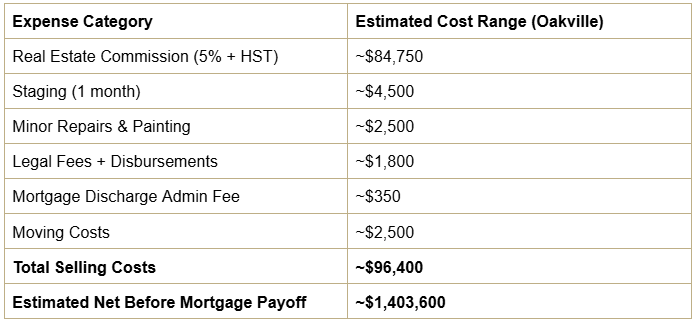
Note: This example excludes any mortgage prepayment penalty (IRD) and assumes Principal Residence Exemption applies. Your actual numbers will vary – contact Haidan Wang for a personalized net proceeds analysis.
Why Choose Haidan Wang & CENTURY 21 Miller Real Estate
Selling a home involves complex legal paperwork, aggressive negotiations, and data-driven pricing. Going it alone exposes you to significant legal liabilities under the RECO Code of Ethics and TRESA guidelines – and frequently leaves money on the table.
Haidan Wang delivers an authoritative, highly customized approach to selling real estate in Oakville. By leveraging the global network and local prestige of CENTURY 21 Miller Real Estate Ltd., Brokerage – based right here in Oakville – your property gains maximum visibility to the buyers most likely to pay a premium.
From neighborhood-specific pricing strategy to seamless, fully compliant transactions, Haidan protects your interests at every step. The result: a confident sale, a stronger net cheque, and a smoother move to whatever comes next.
Frequently Asked Questions
What percentage of the sale price goes to selling costs in Oakville?
Most Oakville sellers spend between 6% and 9% of their final sale price on combined transaction costs, including commission, legal fees, staging, repairs, and moving expenses. Do I have to pay land transfer tax when selling in Ontario?
No. In Ontario, the buyer pays land transfer tax – not the seller. However, if you’re purchasing a new home after selling, you’ll need to budget for it on your new property. Is real estate commission negotiable in Oakville?
Yes. Under TRESA, all commission rates in Ontario are fully negotiable between you and your listing brokerage. There is no fixed or mandated rate. How long does it take to sell a home in Oakville?
Average days on market vary by neighborhood, season, and price point. Well-staged and well-priced homes in core Oakville neighborhoods typically sell within 2-4 weeks. Contact Haidan for current data on your specific area. Do I pay capital gains tax when selling my Oakville home?
If the home has been your principal residence the entire time you’ve owned it, you generally pay no capital gains tax thanks to the Principal Residence Exemption. You still need to report the sale on your annual CRA return. What is the biggest hidden cost of selling a home?
For sellers with an active mortgage, the largest hidden cost is typically the mortgage prepayment penalty (especially on fi xed-rate mortgages calculated using the Interest Rate Differential), which can run into the thousands.
Conclusion: Plan Ahead, Sell Smart
Calculating the cost to sell a home in Oakville comes down to maximizing your net return while minimizing transaction friction. By budgeting for commissions, home preparation, legal fees, and potential mortgage discharge costs in advance, you can plan your next move with confidence and accuracy.
Ready to find out the exact market value of your Oakville property and get a personalized net proceeds breakdown? Request your free home valuation here – it’s quick, confidential, and no-obligation.
Get Your Free Oakville Home Valuation
Personalized, no-obligation market analysis and net proceeds estimate – from a hyper-local Oakville expert.
Agent:
Brokerage:
Phone:
Email:
Website:
Office: Haidan Wang
CENTURY 21 Miller Real Estate Ltd., Brokerage
647-990-6879
haidan.wang@century21.ca
haidan-wang.c21.ca
9-209 Speers Road, Oakville
CENTURY 21 Miller Real Estate Ltd. Brokerage
INFO & SERVICES
CENTURY 21 Miller Real Estate Ltd. Brokerage
209 Speers Road, Unit 9, Oakville, ON L6K0H5
(905) 845-9180
INFO & SERVICES

Independently Owned and Operated. ®/™ trademarks owned by Century 21 Real Estate LLC used under license or authorized sub-license. © 2020 Century 21 Canada Limited Partnership © 2020 Century 21 Canada Limited Partnership
The trademarks MLS®, Multiple Listing Service® and the associated logos identify professional services rendered by REALTOR® members of CREA to effect the purchase, sale and lease of real estate as part of a cooperative selling system. The trademarks REALTOR ® , REALTORS ® and the REALTOR ® logo are controlled by The Canadian Real Estate Association (CREA) and identify real estate professionals who are members of CREA. Used under license. This listing content provided by REALTOR.ca has been licensed by REALTOR® members of The Canadian Real Estate Association. Not intended to solicit properties currently listed for sale or buyers under contract.
Century 21 Canada Limited Partnership currently has franchise opportunities available in select markets across Canada. The intent of this communication is for informational purposes only and is not intended to be a solicitation to anyone under contract with another real estate brokerage operation. This e-mail message contains confidential information intended only for the use of the individual or entity named above. Any unauthorized use or disclosure is strictly prohibited. If you have received this communication in error please immediately delete the e-mail and either notify the sender at the above e-mail address or by telephone.
© 2026 MoxiWorks
